
Your VPN was built for a world where the office was the perimeter.
That world is gone. Replace network-level trust with per-session, per-app verification, deployed in days and migrated in stages.
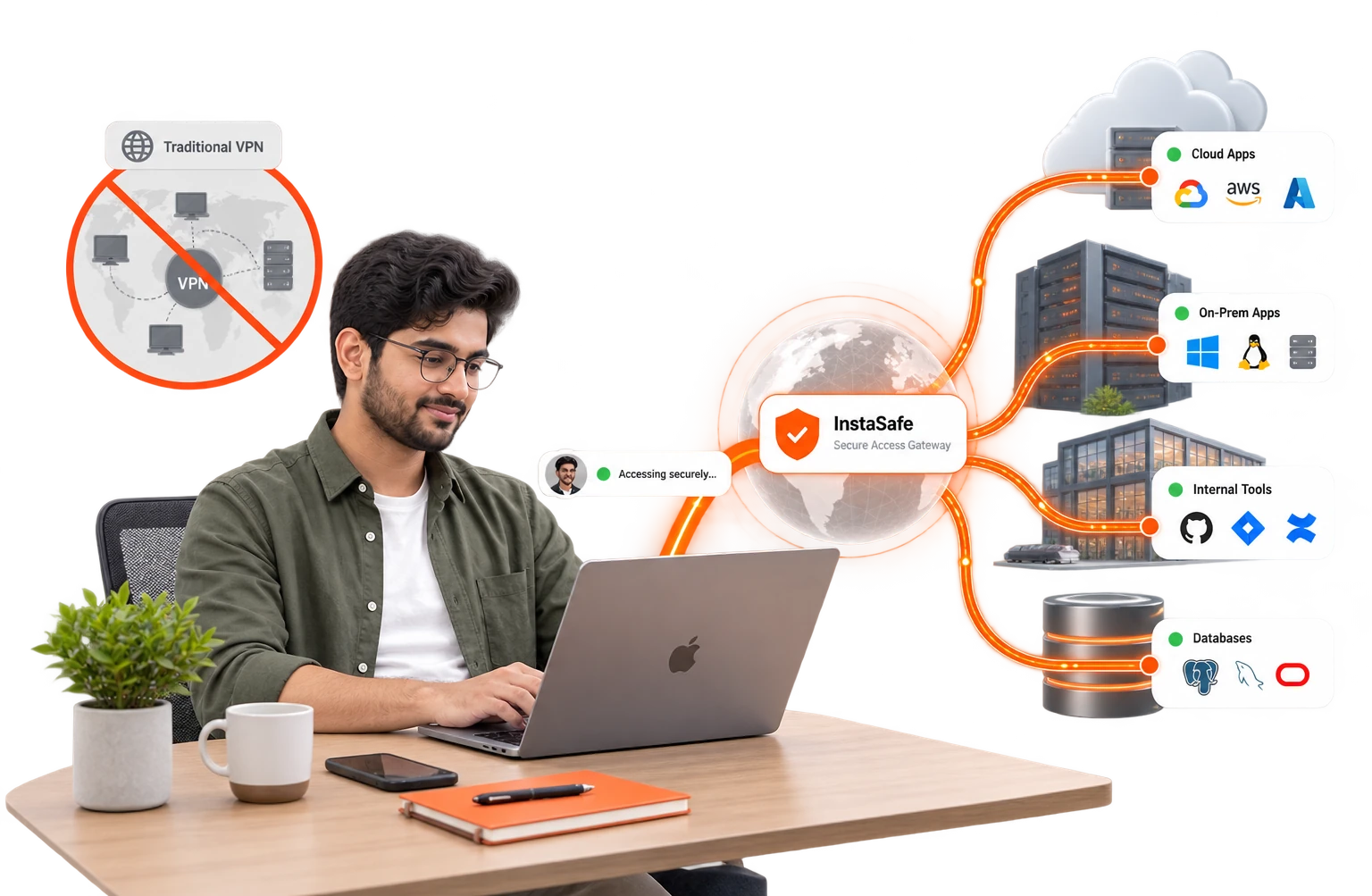
Why is everyone replacing VPNs?
the plain answer
The VPN was a genuinely good answer to a 1990s question: how does a travelling employee reach the office network? Extend the network to them through an encrypted tunnel. The design assumed three things that are no longer true. Applications live in the office (now: cloud and SaaS everywhere), remote access is the exception (now: the norm), and being on the network is roughly equivalent to being trustworthy (now: the single most exploited assumption in security). Four structural problems follow, and no VPN configuration fixes them, because they are the design. That is why the replacement is a different architecture, ZTNA (zero trust network access), and not a better tunnel.
- Network-level access.The VPN's product is network membership. Every connected user is on the inside, and so is every attacker holding a connected user's credentials. Lateral movement is exactly what that membership buys.
- A visible, high-value target.VPN concentrators must listen on the public internet, which makes them permanently scannable. Every concentrator vulnerability opens a race between the vendor's patch and the attacker's script.
- Backhaul latency.All traffic hairpins through the concentrator regardless of where the user and the application actually are. Bengaluru user, Mumbai app, Chennai concentrator: everyone loses.
- Hardware economics.Capacity is bought in boxes, sized for peaks, refreshed on cycles. The workforce doubles and security becomes a procurement project.
- The one application in the request
- For the length of that session
- From a device that passed the posture check
- After the second factor, every time
- And nothing else on the subnet
- The network segment behind the concentrator
- Every file share that segment can see
- Every server that answers a ping
- Every admin console nobody remembered
- A foothold for whoever holds the password
The same twelve questions, asked of both.
InstaSafe ZTNA (zero trust network access) is built on SDP, a software-defined perimeter, where the gateway stays dark until an authenticated request arrives, and where MFA (multi-factor authentication) and the device check sit inside the access decision instead of in front of it.
- ▸Access grantedOne application per sessionEntire network segment
- ▸Lateral movementNo path existsInherent
- ▸Internet footprintBlackened: drop-all plus SPAConcentrator exposed
- ▸Stolen credential isA dead end: MFA and device gateA network foothold
- ▸Traffic pathDirect, split-planeBackhaul via the box
- ▸Vendor sees dataNever: control plane onlyVia appliance or cloud
- ▸Device health check25 checks, 144 rulesNone or minimal
- Per-user policy21 combinations, per groupCoarse
- Visibility202 event types, replayable privileged sessionsConnection logs
- ▸ScalingA configuration changeA hardware purchase
- DeploymentDays, software onlyWeeks plus appliances
- MFABuilt in, 6 methodsThird-party add-on
Switching is staged, not surgical.
- STAGE 1InstaSafe deploys alongside the VPN. A pilot group, typically IT plus one business team, moves first. The VPN is untouched.
- STAGE 2Expansion by team. Access policies mirror your existing directory groups, so the access model moves across with the tunnel.
- STAGE 3Per-team VPN decommission as migration completes. The rollback path stays intact throughout.
No hardware ordered, and no network re-architecture. Users need no retraining either: the portal is simpler than the VPN client it replaces.
What you can retire.
- CONCENTRATORSVPN appliances, and the licensing and refresh cycle attached to them.
- MFA BOLT-ONThe separate multi-factor product bought only to cover remote access.
- JUMP BOXESJump-box sprawl for admin access. Recorded sessions replace it.
- ACCESS SPREADSHEETSThe portal is the entitlement record, so the spreadsheet stops being one.
The alternatives, honestly.
Proxy servers
They hide or route traffic. No identity or device policy travels with the request, so nothing is verified before the connection is made.
RDP
Remote control of a machine. Useful, and a protocol. It is not an access architecture, and it decides nothing about who may connect.
CASB
A cloud access security broker governs how sanctioned SaaS is used. It does not deliver access to private applications.
SDP
Software-defined perimeter: the architecture family InstaSafe implements, where infrastructure stays dark until a request is authenticated.
ZTNA
Zero trust network access, the category name for SDP-style least-privilege access. If your driver is replacing VPN for workforce or third-party access to private applications, this is the category you want.
Replace network-level trust with per-app verification.
Network membership vs one application
The VPN's product is network membership. Every connected user — and every attacker holding a connected user's credentials — is on the inside. Lateral movement isn't a VPN bug; it's the purchase.

alen.joseph · two monitors · what each model reaches

VPN · network member
 erp-frontend
 reachable
 reports-db
 file-share
 hr-portal
 prod-bastion
 build-farm
What changes when the networkstops being the grant
Three consequences of moving the decision from the network edge to the session. None of them depend on catching the attacker first.
Contained breach
A compromised session stays one session. Architecture does that, not detection.
Faster, invisible
Direct connections beat backhaul, and blackened gateways beat scanners.
Software scaling
Growth is a configuration change rather than a purchase order for boxes.
vpn alternative, answered.
Tap a question. If yours is not here, a specialist can answer it.
Talk to a specialist//Ready when you are//
See it running beside your VPN.
One pilot group, policies mirrored from the directory groups you already maintain, the concentrator untouched.
Regulated, air-gapped, or on-premise? See deployment options