Black October, After the First 48 Hours: Exposure, Speed, and the Case for Ring-Fencing Private Applications

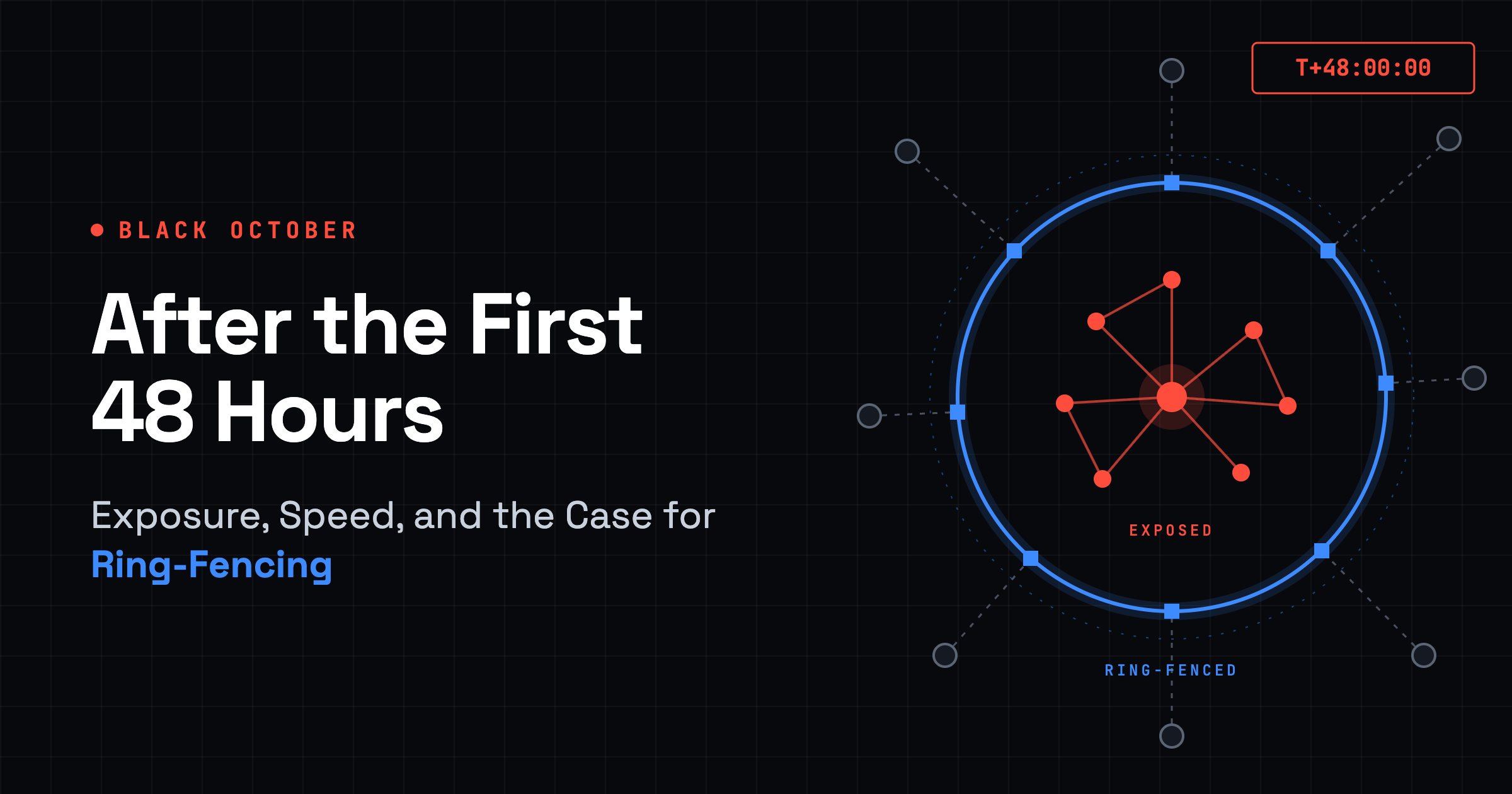
More than 48 hours have passed since the densest stretch of disclosures and precautionary measures that defined mid-to-late October 2026. What has settled is not evidence of a single coordinated campaign, but a compressed sequence of independent failures across runtimes, developer platforms, package ecosystems, certificate infrastructure, and one high-profile data exposure in India. Organizations that could not instantly confirm every system was fully patched and restarted chose temporary unavailability over continued reachability. That choice is worth examining on its own terms.
PHP2Shell and the Decision to Reduce Reachability
On 21 October the PHP project released emergency updates addressing two critical vulnerabilities in the language runtime itself: CVE-2026-109618 and CVE-2026-109619, widely referred to as PHP2Shell. Both are rated 9.2 on the CVSS v4.0 scale. The official technical descriptions are available in the PHP project’s GitHub security advisories (GHSA-w8hw-w9fx-j79w for the out-of-memory corruption path and GHSA-6wmf-4rv5-p3rp for the stale global-state path) and summarized on php.net. The flaws exist in the PHP engine, not in any particular application. A specially crafted request can trigger them before application code executes. Fixed releases are PHP 8.5.12, 8.4.27, 8.3.36 and 8.2.35. Updating WordPress, Drupal, Magento or any other application does not update the runtime underneath it.
Technical details had begun circulating the previous day. Amazon later reported observing exploitation attempts as early as 17 October. Because PHP underpins a large share of internet-facing web infrastructure, the reachable surface was broad. In Japan, Prime Minister Sanae Takaichi posted on X on the evening of 21 October urging operators to verify PHP usage and either apply the imminent patch or temporarily take sites offline; her own site was among those removed from public access. Banks, airlines, railways and ministries paused services. In the Netherlands, DigiD, the citizen portal MijnOverheid, the Tweede Kamer, the National Cyber Security Centre’s own website, the Port of Rotterdam, hospitals and the Schiphol app were taken offline as a precaution. Comparable steps occurred in Finland, France, Germany and elsewhere. Wikipedia and several commercial services disappeared for a period. Officials in multiple countries later indicated they had not observed confirmed successful exploitation at the moment of the shutdowns. The dominant calculation was simple: uncertainty about patch status made continued public reachability the higher-risk option.
Parallel Issues Across Platforms, Packages and Trust Infrastructure
The same window produced additional high-severity problems. GitLab disclosed a CVSS 10.0 integer-overflow vulnerability in its regular-expression compiler (CVE-2026-110264) that affected self-hosted instances dating back to version 7.0 in 2014. An earlier CVSS 10 issue in the same family had been patched only days before; those earlier fixes did not cover the later bug. LiteLLM’s package distribution was compromised with credential-stealing code. Railway paused deployments after customer secrets were potentially exposed, requiring widespread rotation. Zeabur faced further issues and moved toward ceasing operations. Node.js and related components also required attention.
Certificate infrastructure was affected independently. Eight eMudhra intermediate certificate authority private keys were generated with catastrophically insufficient entropy during a 2025 key ceremony; one private key was the integer 4. Mozilla received a report on 17 October and blocked the certificates in Firefox within hours; the details are recorded in Mozilla’s Bugzilla (bug 2083449). Chrome, Apple and Microsoft took parallel action. eMudhra revoked the intermediates and stated that none of them had issued end-entity certificates and that its root keys remained unaffected. The episode demonstrated how a process failure in key generation can force rapid, ecosystem-wide distrust of certificates that many systems had previously accepted without question. Non-browser software and custom trust stores required separate review.
In India, State Bank of India disclosed on 21 October that a preliminary review of roughly 375,000 records that had appeared on the dark web identified 3,897 customer records containing personally identifiable information. The bank said it was alerted on 16 October by its threat-intelligence provider, the Defence Cyber Agency and CERT-In. The exposed data included names, mobile numbers, dates of birth, email addresses, residential addresses, branch and customer identifiers, and metadata associated with loan and lead records. SBI engaged a CERT-In-empanelled firm to investigate and stated that the incident was not expected to have a material impact on core operations or financial performance (Reuters, The Hindu). Reports referenced claims by an actor using the name Siriusim; SBI has not confirmed the full extent of those claims. The disclosure placed a major Indian financial institution’s data-exposure event alongside the global runtime and trust-system issues of the same week.
Why Response Windows Have Shortened
Several structural factors explain the intensity. The affected components sit beneath or beside large numbers of production systems. Early technical detail reduced the time available for orderly preparation. Separately, investigations into AI-assisted campaigns—including the use of agentic frameworks such as ARTEX in combination with multiple models—have shown how reconnaissance, validation and follow-on activity can be divided and iterated at machine speed. The practical result is that organizations can no longer reliably assume a multi-day period in which every exposed system can be fully inventoried, patched, tested and restarted before opportunistic activity begins. Inventory gaps compound the difficulty: forgotten applications, appliances that embed vulnerable runtimes, and private systems that remain reachable under an assumption of network trust all extend the period of uncertainty.
Zero Trust as a Standing Ring-Fence
Continuous verification of access supplies a practical control that operates independently of patching timelines. When private applications are placed behind identity-, device- and context-based checks, unauthenticated or untrusted traffic does not freely reach them. The application remains available to authorized users and processes; the path by which it can be discovered and interacted with is constrained. In a disclosure cycle of the kind just experienced, this ring-fence reduces the number of systems that must be treated as immediately reachable while teams complete runtime updates, dependency upgrades, secret rotation and worker restarts.
The benefit is not that patching becomes optional. It is that the organization gains a controlled window in which remediation can proceed without every internal application remaining part of the broad scanning surface that opportunistic actors target in the hours after a vulnerability becomes public. Segmentation further limits how far a single compromised runtime or stolen credential can travel. For estates that include internal tools, administrative interfaces, line-of-business systems or hybrid deployments, the same principle applies both to remote access and to internal networks that have historically been treated as trusted by default. Continuous verification replaces the assumption that presence on the network equals authorization.
Priorities Once the Immediate Wave Has Passed
More than 48 hours on, the near-term actions remain concrete. Confirm PHP runtime versions on both internet-facing and internal systems and move to the fixed releases, followed by worker restarts. Verify self-hosted GitLab, Node.js and related components against the latest advisories. Rotate credentials that may have been exposed through affected platforms or packages. Review trust stores and certificate chains for residual reliance on the affected eMudhra intermediates, particularly in non-browser software. For the SBI disclosure, customers should treat unsolicited messages that reference personal details with caution and avoid sharing one-time passwords or credentials.
The longer-term priorities that follow from the week are equally clear:
- Maintain an accurate, continuously updated inventory of runtimes, private applications and platforms that hold secrets. Systems that are unknown cannot be patched or isolated.
- Treat patching and verification as ongoing operations. Where full remediation cannot be completed immediately, isolate or apply compensating controls while the permanent fix is prepared and tested.
- Reduce the reachable surface of private applications through continuous verification. Zero Trust access ensures that only authorized identity and context can reach the application.
- Apply segmentation and least privilege so that compromise of one component does not automatically yield broad access.
- Exercise isolation procedures. The ability to remove systems from reach quickly proved useful for multiple organizations this month.
These measures complement established practices such as phishing-resistant authentication, strong unique credentials with multifactor authentication, and dependency hygiene. They address the speed and interdependence that the October disclosures made concrete.
How InstaSafe Enables Private Application Ring-Fencing
InstaSafe’s Zero Trust Application Access capabilities are designed for private application infrastructure. Organizations can place internal applications and critical systems behind continuous verification of identity and context, so that access is granted only after those checks rather than being assumed from network location. The model works across hybrid and on-premises environments, allowing private applications to remain available to authorized parties while remaining hidden from unauthenticated discovery and scanning.
In operational terms, this creates the ring-fence that shortens the period of uncontrolled exposure during vulnerability cycles. While teams inventory PHP runtimes, update open-source libraries, rotate secrets and apply patches, the applications themselves are not left continuously reachable by unauthenticated traffic. Least-privilege policies and segmentation further limit lateral movement if any component is compromised. For organizations managing private application estates under regulatory or operational constraints, the approach supplies a consistent control layer that does not depend on every system being patched in the first hours after disclosure.
The events of this October will not be the last of their kind. Organizations that know what they are running, can isolate it when necessary, and have already reduced how much of their private infrastructure is reachable without verification will absorb the next cluster with less disruption. Temporary offline decisions bought time for many this month. Continuous Zero Trust access for private applications turns that same principle into a standing posture.